That Sound You’re Not Hearing in Your Business Could Be Fatal.

If we’ve learned anything over these past six, going on seven years of covering the internal social collaboration sector, it’s that the social web has become a catalyst for intellectual curiosity.

folon

“Fools,” said I, “You do not know.
Silence like a cancer grows.”   Simon and Garfunkel


If we’ve learned anything over these past six, going on seven years of covering the internal social collaboration sector, it’s that the social web has become a catalyst for intellectual curiosity. Tribes are forming everywhere with the growing popularity of niche sub-groups from LinkedIn to Google Communities. As quickly as you can say “add me,” this socially savvy collective is connecting, learning, and sharing with effortless, timeless ease. In other words, the long tail of interesting projects and topics is attracting talent to shared interest groups with like-minded professionals every moment around the social globe.

The future of the enterprise is already here albeit unevenly distributed in blossoms of network connections.  What are not unevenly distributed, are the individuals that “get” social collaboration and new modes of working. Small networks of professionals have always been present in the business world, but what’s different in the social era is the degree to which strong bonds and real relationships are forged on a foundation of meritocracy and reciprocal trust.  Not only do we know who you are, we observe your behavior in the network, and make judgments about your contributions and motives.  And absent an economic incentive to work together, individuals are sharing for the sheer pleasure of learning and teaching.

With a healthy, organic socio-collaborative corporate philosophy and pleasing UX platforms to foster it, talent will not stray outside the corporate walls for intellectual stimulation.  The corporate town hall will be buzzing with ideas and positive energy.  But, if your internal network is deathly quiet, or worse – non-existent, you can count the hours before your best performing future-worker talent connects itself to that outside world permanently, leaving you wondering why you didn’t see the big shift soon enough to make the change that could save your company.

The key to keeping your talent in-house and focused on organizational goals is to ensure the company’s mission is in sync with individual passions and interests. Command and control has been rendered obsolete in a galaxy of independent thinkers. It can putter on in the short term, but will never survive the long term.

I was poring over the lengthy back and forth between Nick Carr and Clay Shirky over the future of the book publishing industry a few weeks ago. At the same time, I stumbled upon this timeless piece by Boston Consulting Group founder Bruce Henderson about the difficulty of effecting change in a large organization.  PUB DATE: 1968   Henderson points out there are predominantly three dependent reasons why companies fail to change and ultimately fail altogether:  executive management doesn’t recognize or believe there is a fundamental shift underway important enough to affect the business, leadership doesn’t champion the change, and by the time they figure it out, it’s too late. In the final analysis, what hit me like a ton of Blockbuster brick and mortars is how foolish it will be for large enterprises to reject the premise (and practice) of social collaboration.  In the same way that media content is being re-purposed, repackaged, and re-distributed, so it will be for the knowledge assets of knowledge workers.  The degree to which executive management can recognize these important trends and retain its intellectual capital will be key to managing the shift.

Bonus:  A recent study by the CEB links healthy collaboration to breakthrough performance

Fracking for Value in the Enterprise

This year in 2012, now that Jive customers are relatively comfortable working in this new way, Jive is pushing customers further and helping them discover the business value buried in their organization that can be extracted. It’s kind of like fracking in the bedrock of the enterprise for stored value.

Finally getting around to publishing some thoughts from JiveWorld 2012.  Jive has always been a leader in pushing the hot buttons on social.  In the beginning, at JiveWorld’s inaugural event, the theme was decidedly about educating the market to “think different” and ingrain a social orientation toward reinventing work and customer outreach.  The market actually needed a lot of hype to get some lift in the early days.  Jive set a high bar on energizing its early adopter customer base.

I wrote then, in 2009:

It takes a startup like Jive to inject innovation, creativity, passion, and excitement to this sector.  Jive is releasing a ground-breaking set of features that will set a new high bar for excellence in the category.  I’m certain the tech bloggers will cover the announcements in depth, but in brief, Jive is announcing an iPhone app (plus an email-driven enriched BlackBerry experience), very slick MS Office integration, and a bridging capability that will unite internal and external communities.  All this in addition to the series of announcements Jive made previously that include social media monitoring and a SharePoint connector.

What’s significant about the Jive announcements is the company’s commitment to releasing timely, innovative new capabilities in response to customer feedback and requests.  I’m here at JiveWorld, the company’s first customer event.  From the energy circulating in the crowd here, it’s obvious to me Jive is customer-driven and loyalty from Jive’s customers handily delivers repeat revenue as well as product improvements.

Jive’s ability to manage the books, pay careful attention to its user base, invest in educating its partners and employees, rationally identify its target market, as well as manage its growth effectively squarely positions the company uniquely from other startup competitors in the space.  Further, it accentuates the advantage startups have over the large enterprise vendors where releases are timed in years, not months.
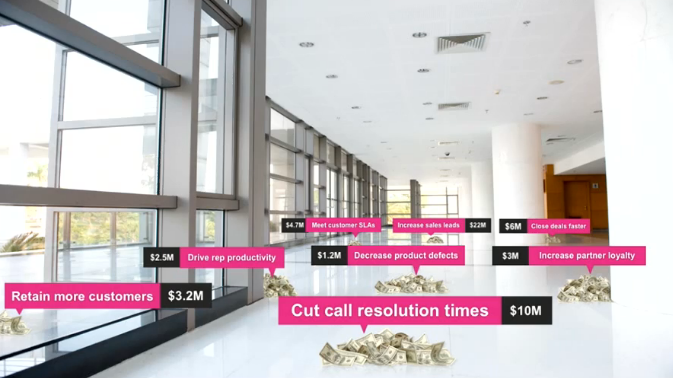
This year in 2012, now that Jive customers are relatively comfortable working in this new way, Jive is pushing customers further and helping them discover the business value buried in their organization that can be extracted.  It’s kind of like fracking in the bedrock of the enterprise for stored value.  Chris Morace, Jive Chief Strategy Officer, calls it finding the “money laying around” in your organization when you start viewing your organization in a modern way and start using social technology strategically.  With the 6.0 release, the Jive platform itself is morphing into a dynamic institutional intelligence engine that “knows” you and can help you improve your job performance. This is the kind of education and innovation that marks the next stage of evolution in social business transformation. The company has published a guidebook for customers on Business Value with over two dozen specific examples of how Jive customers are realizing hard dollar savings, productivity gains, improved outcomes, and accelerated outcomes.

It occurred to me during the conference that Jive is the real deal on this and way ahead of the social brat pack of competitors pushing into the space.  In the end, it will be great to see all social platform vendors educating customers on where and how to apply social for business advantage, but so many of them are still where Jive was a few years ago relative to basic evangelism and market education.

Value case – Teletech

That said, I picked up on a case study that interested me from my fellow Enterprise Irregular compadre Esteban Kolsky’s panel on “Approaching Customer Service from the Customer’s Point of View.”  It was a comment made during the opening remarks by panelist Lamont Exeter, Executive Director at TeleTech. He said that working socially had actually enabled the company to change a business process that led to a vast improvement in how they handle their escalation process on customer trouble tickets. Considering TeleTech is a the leading business process outsourcing provider of technology-enabled customer experience solutions, I found this to be not a trivial remark. For years, I’ve been pointing out that the opportunity in social is to improve outdated business processes that were originally designed for the industrial age. “Socializing” existing business processes will only get us partially to the potential results inherent in a true social business transformation.  This is exemplified in the TeleTech case.

I followed up later with Exeter, and he explained in detail the business process improvement he mentioned on the panel. A singular changed process resulted in several gains for a TeleTech client. In the old way of doing things, a customer would call with an issue. If a process or procedure change was required , the associate would send an email or manual spreadsheet report and a team leader would open up a ticket.  Then, IT  or a subject matter expert (SME) would either fix the issue and close the ticket or close a ticket without communicating the reason back to the associate.  It generally took about 5 days, on average, to move through trouble tickets and in neither case would feedback be provided to the associate who initiated the ticket. This resulted in associates feeling as though they were not “heard” or valued.

Now, with TeleTech’s Iris community (powered by Jive), frontline employees can comment on a process and the SME is immediately notified – cutting out all those time-consuming steps.  The SME gets a notification from the frontline team and has 24 hours to reply. The official new time to resolution has been slashed to 17 hours and 43 minutes – a 567% decrease!  The process has a transparent gamification element that motivates employees to close out tickets as fast as possible too.  In addition,  the client cut eighty-eight percent of their ticket reworks because everyone sees the same problem and common answers are available on the community.  It’s internal “crowd sourcing.” The time saved on this resolution efficiency enabled the client  to reassign thirty-three percent of its staff to more productive work, further saving the client labor costs.  By changing this process, TeleTech increased customer satisfaction, saved on labor costs, and now has one of the most competitive low in-bound call volume records in its industry.

Another interesting aspect of the TeleTech case study is the deliberate integration of Jive with 8 different technology platforms including Bunchball (for gamification), leading CRM systems, a learning management system, an employee performance system, and a micro-learning tool.  This myth-busts the notion that all social platforms are islands of irrelevance.  The smartest companies are way ahead on the integration curve and weaving social into the corporate enterprise stack by clever use of API integration and other web services.

All told, the conference was great for all the right reasons.  It was pure pleasure to talk to Jive customers at our 7Summits booth on the exhibit floor, learn from the presenters, and indulge in the hyper-networking that goes on at industry events.  I look forward to continuing to expose the business value cases I’m uncovering with our clients.  Some of them, frankly, are blowing my mind.  For a better understanding of how 7Summits approaches unlocking the value in enterprise by retooling business processes for social, see this introductory presentation by R.J. Reimers.



Two Surprising Statistics on Social Business Progress in the Enterprise

Over the summer, we conducted a short survey among the Social Business Council members to gauge where large enterprises are regarding their progress introducing social to the enterprise.  The request was made by a Council member who was looking for some hard benchmarking data he could share with his team.

We wanted to answer the question:

“How far along are the leading early adopters?”

The results were eye-opening.  So many of us who track the market are always saying how early we are, how we are just at the beginning of this transformation,  how it could take a decade or so to really start seeing the fruits of our efforts, etc.   But, we really didn’t have a lot of  hard evidence.*  Now we do.

The first eye-opener was where early adopters report they are.

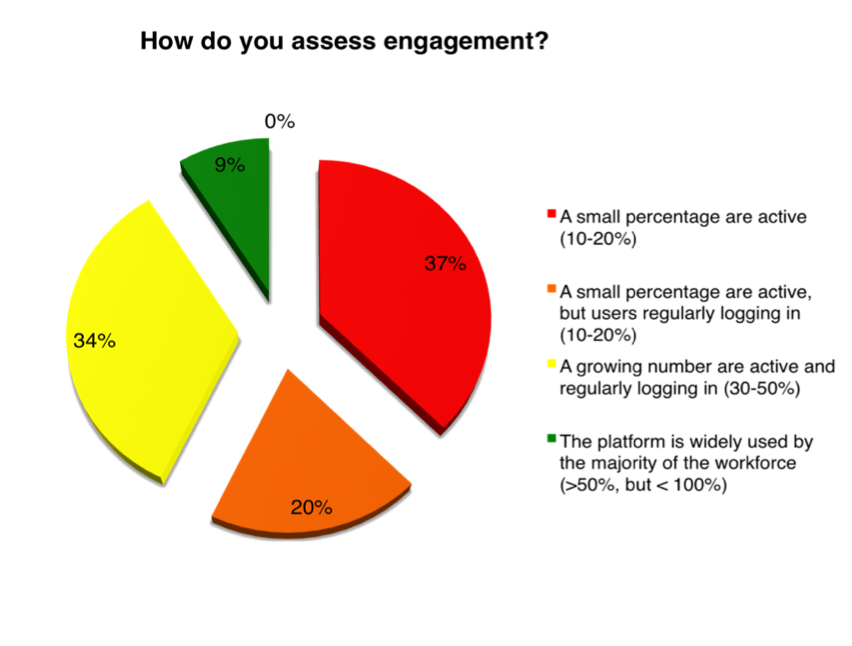
Nearly two-thirds of the companies surveyed (57%) reported that that only 10-20% of their eligible workforce is active on the platform.  The flip side of this statistic is, of course, that there is a lot of room to grow, and it opens up large opportunities for consultants, vendors, and social business advocates to help companies succeed here.

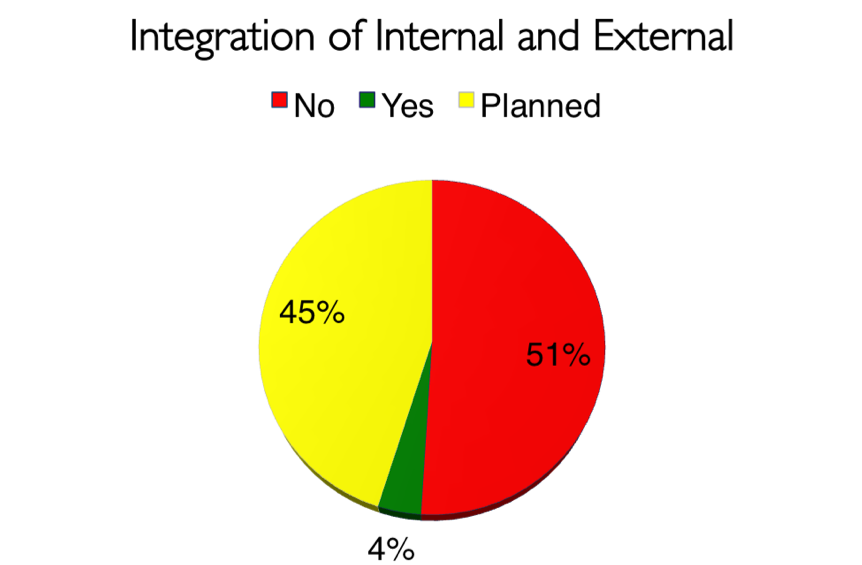
The second big reveal for me was the number of companies who indicated there is no real integration between their external social initiatives (social media/customer outreach) and their internal social efforts (a.k.a. Enterprise 2.0).  It was nearly unanimous: 96% reported there was nothing today that integrated their social business initiatives, although nearly half reported this was on the planning board.

In short, the survey asked 10 simple questions, yet essentially debunked some of the hype that circulates on the social web regarding the state of the market. In essence, the social business phenomenon is real, but all stakeholders vested in the market would be well-advised to exercise some patience in expecting game-changing results.

Dion Hinchcliffe wrote a longer piece on ZDnet with some of his takeaways, and you can download the report here.

*These survey results reflect the progress of  a unique cohort: very large enterprises with more than one billion USD in annual revenue that are actively engaged in a social business initiative.  Smaller organizations may report different results.


Setting Sights on New Heights with 7 Summits!

Snapped a shot of the Marquette crew while walking to the office last week. Thought it was a fitting visual metaphor.

Announcing my new gig today! [Press Release]  I’ve accepted an offer to work for a gutsy startup with big plans: 7 Summits. Based out of Milwaukee and Chicago, this fast-growing team has been #killingit building award-winning Jive communities that succeed on a foundation of strategy and solid user experience to deliver clearly articulated business results.

I first heard about the firm via my friend and ex-Moxie (then, nGenera) colleague, Steve Elmore. Steve had recently taken a position there as VP, Social Business Strategy.  I’ve known Steve for a long while, and he’s definitely one of the handful of my industry friends that sees the opportunity for social business through the same lens I do.  When Steve started telling me about the culture and vision driving 7Summits, I felt like it was kind of a dream come true for both of us if we could both be part of a team that shares our core social DNA.

While I was researching career opportunities in the market, I received a couple of other great offers.  But, during my evaluations, I kept coming back to 7Summits.  I ultimately made the decision on a short list of defining criteria:

Experienced Leadership that Executes with Rigor

7 Summits is exceptionally well-managed.  There is a mature and focused approach to goal-setting and performance that permeates every facet of the business. As a result, the company is on a strong trajectory of organic growth. The founders, Paul Stillmank and RJ Reimers, held executive positions at Manpower, Whittman-Hart, and Accenture and know how to scale a services business. The core focus on business direction, achievement, and results combined with a sincere intention to build a company culture with character and integrity at its core is refreshing and highly attractive.  One of the most impressive indicators for me was the outstanding reputation the company enjoys among the clients I surveyed.  Most especially because the company has done very little to elevate its brand.  In other words, the reputation was earned the hard way with performance vs. promotion.

A Culture Based on Shared Values of Openness and Inclusion

The company is run as a social business.  Content is openly shared on the company’s internal Jive instance and daily stand ups occur to gauge how everyone in the company is doing.  Every voice matters and the company operates as a team. Culture is the single greatest asset to a services company. I learned this first hand in my experience covering the largest IT services players in the 90s.   During the interview process, I perceived a company culture based on group goals, a dedication to excellence, and a genuine concern for the customer. (Fantastic!)  My personal goal is to fit in seamlessly with the team and expose this tremendous esprit de corps to the outside world.  The company culture and story will be a magnet for customers, partners, investors, and talent for years to come.

A Platform for Social Business Advocacy

As a trusted advisor to its clients, the company matches passion about the promise of social business transformation with purpose and provides its clients a roadmap for how to achieve the promised results.  And the “soft” side of social does not get buried in the business of delivery.  In fact, “Enhancing people’s lives” is part of the company’s mission statement.  In other words, this is a company that gets it. Internal social, external social, and everything in-between.  It’s the first dedicated firm in the U.S. I’ve come across whose business is centered exclusively on delivering social business solutions to every corner of the market: Marketing, IT, or any progressive business unit that wants to introduce social capability to operate more effectively.

In short, I look forward to introducing this company and the transformational work it is doing to my regular readers, fans, and friends of social business.  We will be heading to JiveWorld next week and I will be proud to participate in the fun programs the company has in place to galvanize the believers.  (Please let me know if you’ll be there!) Additionally, the company is on a growth trajectory and is recruiting smart talent looking for a new home to exercise their passion for this work that we’ve all come to love.  I encourage you to apply for any of our open positions.  If I know you personally, make sure to drop me a note too, so I can add some texture to your application. You can reach me directly at susan.scrupski at 7summitsagency dot com.  And keep checking the job board.  New positions are going up all the time.

Onwards!


Pinch me. SAP is Dreaming up Social for the Enterprise.

With Patel’s new position, SAP recently moved “social” into its cloud group where it will support all SAP suites and concentrations (CRM, for example) in a new social platform that will be structured to support the business horizontally and seamlessly across on-premise and cloud offerings. The group is building what they’re calling, “Project Robus.” (Latin for resolve or purpose.)

This was my 5th year attending SAP‘s gala SAPPHIRE event.   You can see from my previous blog posts, a recurring theme in all of them is SAP’s cold shoulder toward all things social.

2008What I-know-I-don’t-know about E2.0 and SAP from Sapphire ’08

 “Enterprise 2.0 is just not a burning issue on the minds of top SAP execs… SAP execs mirror the same sentiment as our executive clients: they have serious businesses to run– not a lot of time for the giddy consumery stuff. SAP software fuels the nitty gritty of hard-core business processes for most of the largest enterprises in the world. Where blogging (for example) fits into getting a raw material through the factory floor to a finished product, booked in inventory and ready to move through a supply chain is just not obvious to me right now. So the likelihood of an Enterprise 2.0 bolt-on to SAP is just as slim as it is naive.”
“So, once again, SAP invited me to its annual SAPPHIRE and ASUG event. I find myself wondering if SAP will get return on their investment in me once again. The answer is, probably not…  The reality is SAP and its global customer base are just not ready for the socialization of the enterprise. It’s just not a topic that commands attention at this massive event (despite my valiant efforts to bring it up in every executive briefing). The majority of conversations at SAPPHIRE revolve around common themes such as decision-making, analysis, data, spreadsheets, databases, reports, statistics, and business processes. In other words, the real work that goes on in real businesses.”
“For me, SAPPHIRE presents a unique opportunity to re-calibrate and diffuse the hype chamber that self-perpetuates around the 2.0 phenomenon.   SAPPHIRE is the 2.0 Rehab that I voluntarily commit myself to every year for one week. Only at SAPPHIRE do I get an opportunity to see the world the way my Council members do– that the 2.0/social business hoopla is enjoyed and shared by a small minority of corporate professionals.  Through the eyes of SAP customers and the SAP eco-system, I gain unique insight into the tremendous task ahead which involves a host of issues, not the least of which is tying 2.0 transformation to the enterprise business processes that run the world’s most successful businesses.”

This year, in 2012, it looks like things might be taking a new turn.  At least the lip service is on message.  Readers of this blog should know SAP recently hired the #e20 community’s good friend Sameer Patel to assume the position of Social Czar at SAP.  Patel has his work cut out  for him, however.  The two social platforms that qualify as social at SAP are StreamWork and SuccessFactor’s Jam (formerly CubeTree).  Two platforms that, frankly, don’t see much social traction in large enterprise. Neither one ever comes up in a landscape conversation of social collaboration software, and turning up examples of hard core users has been pretty slim among those of us who keep an eye on this category.  CubeTree, in fact, was never a player.  With Patel’s new position, SAP recently moved “social”  into its cloud group where it will support all SAP suites and concentrations (CRM, for example) in a new social platform that will be structured to support the business horizontally and seamlessly across on-premise and cloud offerings.  The group is building what they’re calling, “Project Robus.” (Latin for resolve or purpose.)

What’s probably most significant about Project Robus is that all development is being led by SuccessFactor’s co-founder and  technical cloud guru, Aaron Au. Au  is the lead architect and will run engineering for the project.  The operating vision behind the socialization of SAP’s massive ENSW footprint hinges squarely on integrating social with business process.  As Patel describes it, “This is core infrastructure.  It’s like application servers and middleware.”  The orientation is on business activities first, and social features second.  In other words, use cases will drive how and when social interacts with a business process.  All social presentations within the SAP product suite will touch the Robus platform.  My blogger colleague Alan Lepofsky describes it as “social plumbing.”

The pressure to deliver social is on SuccessFactors CEO Lars Dalgaard who is the Board executive advocate for social. Dalgaard is breathing new life and new ideas into the software behemoth.  He appears to have much support from co-CEOs Bill McDermott and Jim Snabe, as most cloud and social questions asked at the scheduled media/analyst interview were turned over to Dalgaard.   There is evidence in the market that SAP has finally embraced the principles of a more collaborative, social business world (see Jim Snabe’s opinion piece in the Financial Times, “Social Networking and the Future of Business“).

I want to believe SAP will pull this off, but there is a small part of me that wants to scream, “You’re doing it wrong!”  It’s as if SAP is looking for a software solution to a human opportunity.  Focusing on the unstructured data and time spent between workflows is anathema to SAP’s heritage and corporate culture.  And even if the executive and management ranks see the opportunity, the rank and file are going to be puzzled.  We were sitting at dinner with a number of SAP mentors and I asked if any of them were using StreamWork.  All heads shook no.  One mentor said he wouldn’t even bother logging on.  My enterprise blogger friends roll their eyes when I talk about how social is about reinventing the way we work.  But they’re not seeing the changes I’m seeing in large organizations that are successful with social reinvention.  Luckily, I’m not the only one talking about this.  The enterprise is ready for a different way to work.

But, like Kermit, it’s the lovers, the dreamers, and me.  Those of us who are under Social Business’ spell are true believers.  I hope Lars Dalgaard and the SAP executive team can execute on the human potential of social, but I’m still a bit skeptical.

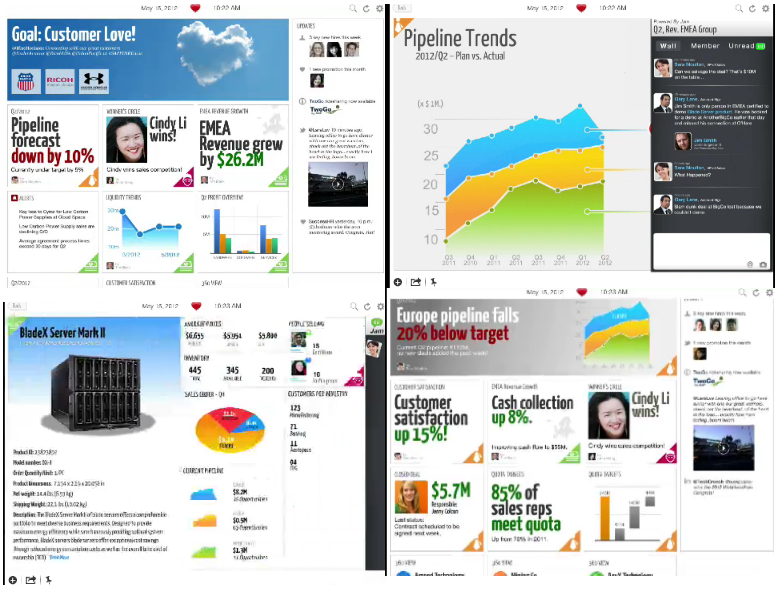
See Dalgaard’s “dream” app.  Here’s to hoping they pull it off.

Social Business by the Numbers

While the blustering goes on in the blogosphere, I thought I’d (ahem) cut to the chase and get serious about the Social Business opportunity in, well, spreadsheet terms. I popped into a little discussion  between Adam Holt at Morgan Stanley and Tony Zingale and Bryan LeBlanc  of Jive Software (JIVE).   Although specific business gains directly related to Social Business can’t always be divulged by large companies for a variety of reasons, we can take a look at the category as an investment play  and make some judgments about its viability. To that end, here are a few key points CEO Zingale and CFO LeBlanc made to the investor community:

  •  What’s different about the social business category is there are multiple entry points for a sale.  The sale could come from IT, Sales, Marketing, Customer Support, HR, Corporate Communications or more often than not a  Business Unit.  < Key learning: this is different in software investing.  Buyers abound.
  • The Social Business story has reached a tipping point. No longer are sales “missionary” sales.  There are line item budgets for social business software, and large RFPs are on the market from F1000 companies who are investing in these platforms.  Further, every software company is now incorporating social into its product suite, albeit mostly still relegated to “silo” functional software for specific departmental needs (Sales, HR, etc.).
  • Social Software is not a “replacement” category of software like  Salesforce was with Siebel or Workday is with various ERP modules.  This is not a cloud v. on premise alternative. (Jive sells both on and off premise.)
  • The deals are larger.  Jive closed three million dollar plus deals in the fourth quarter of 2011.  Large institutions in various industry segments (PwC, Thomson Reuters, and Ace Insurance) chose Jive  to introduce a new way of working to their firms.
  • Social Business software delivers real value to every knowledge worker in the enterprise. The market opportunity exceeds that of traditional enterprise software which typically serves a discrete business unit function (manufacturing, HR, finance, sales, etc.).

The JIVE call has some interesting nuggets about how JIVE is uniquely poised to compete against the other two main competitors in the enterprise space: IBM and Microsoft, but the essence of the story is about the legitimization of the social business category for the institutional buyer. More importantly, this investor story is not even about technology and tools. It’s about organizations behaving differently by connecting and engaging with constituents. The tools will come and go, but the behavioral change is a paradigm shift well worth the early entry.

Jive management took the company public on  December 13.  Since then, the stock has doubled and Jive’s market cap is $1.24B. Institutions hold 82%, so lots of pension funds are betting that social business is real. I’ll side with Wall Street on this one.