SXSW through the Enterprise Prism

There was something about SXSW that reminded me of trick-or-treating. It’s an amazing opportunity to travel around in groups (in various costumes) and collect delicious bite-sized morsels of innovation. But it reminded me of something my (once) 3-year old son said after he flopped into bed after his first Halloween night, “Let’s do that again tomorrow!”

SXSW is a once-a-year phenomenon, but a great harbinger of trends. Much of the conversation is about web-related design and measurement, politics, the social media revolution, and every-possible-thing-that-could-ever-be-possibly-said about Twitter. In the mix of fun and frolic, there were a couple gems that I picked out that would bring value to the enterprise.

Pepsicozeitgeist

One of the best, IMO, was Pepsi’s sponsorship of the PepsiCo Zeitgeist Twitter Visualizer. This eye-candy visualizer was created by Amy Hoy and Thomas Fuchs, two Ruby on Rails/Javascript knighted heros and the brains behind Freckle and Twistori. Pepsi turned to NY digital strategy stealth firm Undercurrent to link its brand to SXSW. Pepsi had a number of initiatives at the show, but the zeitgeist effort was really interesting to me on a number of levels. Before I discuss how enterprise could make practical use of such a visualizer, I want to highlight how courageous it was for Pepsi to get behind the zeitgeist project. I spoke briefly to Pepsi’s Josh Karpf, Manager Digital and Social Media and Bart Casabona, Sr. Manager, Communications/New Media about it. “It was a leap for us; it hadn’t been done before,” said Casabona. Jordan Berkowitz, Group Director at Undercurrent pointed out that when they designed the application, there was to be, “No filtering based on content.” The PepsiCoSXSW team was integrated into the social media scene and knew there might be objectionable content broadcasting at the event and online, but wanted to create an authentic, digital experience with the Pepsi brand. Even though we were in bluedot Austin, where weird rules, it occurred to me a corporate brand like Pepsi had a lot at risk attaching its logo to random tweets. What I loved about that, however, was the giant brand was willing to move outside of its comfort zone. And the brilliance of the zeitgeist project is Pepsi integrated its brand into the customer experience of SXSW in an authentic and subtle way. “We’re social media folks,” said Karpf. In other words, they get it. Even though the community acknowledged Pepsi was behind the visualization, Karpf pointed out they were saying, “This is a brand, but it’s still awesome.”

The complete visualization can be seen in a series of one-minute videos on the Pepsicozeitgeist YouTube page.

For enterprises, it’s easy to see how this live-pulse tracking visualization could be used during a large Enterprise event such as Oracle’s OpenWorld or SAP’s Sapphire and ASUG events (providing, of course, everyone was a faithful Twitter user). But even beyond live events, the visualization could be customized to monitor conversations among key customers and fed to field sales forces. The location-based data could provide some very interesting G2 for key accounts. HR and internal communications groups could use the visualizer to monitor employee sentiment, as well. The uses go on and on. Worthy of some exploration.

Apture

Another impressive tool was Apture. I ran into CEO Tristan Harris at one of the sessions. Harris himself impressed me because he pitched me while waiting in line from his iPhone. He had his demo-to-go all queued up (presumably, in case he ran into, say, a reporter). In the blogger’s lounge, I signed up. I had a little trouble signing onto the demo with Apture because I don’t manage my own blog server files, but it seemed easy enough to install once you got past that hurdle. Apture is a free blogging tool that lets you instantly find any type of media and link them in-place. It’s used by the Washington Post, BBC News, and since SXSW, The New York Times. I see an enormous potential for this product inside the enterprise… again, providing we can get the Enterprise onto collaborative 2.0 platforms.

Check out Apture’s Twitter demo.

iStockPhoto

I also really appreciated a discussion I had with Marketing Manager, Yvonne Beyer, at iStockphoto. picture-1Here’s a tip for iStockphoto fans: CopySpace (TM). Check it out under Advanced Search. It enables you to “grid” your search by the area where you need room for copy on an image. GREAT tool for those large image slides. Not sure everyone is using iStockphoto in the enterprise, but you should definitely add this to your DIY toolkit. Some quick stats on iStockphoto include the company adds 40,000 new images and other media products a week that are vetted by 100 inspectors around the world. It has paid over $1.1M in royalties to artists, and many members of their community are making more than six figures with iStockphoto. Not really a pure enterprise product, but a great service for business folks who want to create their own visuals coupled with a strong business model that depends on community.

Even though SXSW is in Austin, I’m debating on going next year. There really wasn’t a lot of good enterprise content to be found. My plan is to liven up the Enterprise 2.0 conference (June, Boston), so we have a pseudo-sxsw of our own. I made a recommendation to the Advisory Board that we actively solicit sponsors for more parties and fun venues. Zoho sponsored a cruise a few years ago that was a lot of fun, for instance. Even though the sessions are always great, the best reason to attend events is to network in the traditional sense– meet and greet and share war stories face to face.

Hope to see you in Boston. Pack a lampshade.

UPDATE: Yvonne Beyer pinged me with a staggering correction: iStock pays out around 1.1 million in royalites a WEEK. She also added Lise Gagne from Montreal is one of the iStock contributors disclosing she makes 6 figures with well over 830,000 downloads to date. www.istockphoto.com/lisegagne
SXSW: What Happens Here Doesn’t Stay Here

dsc00067

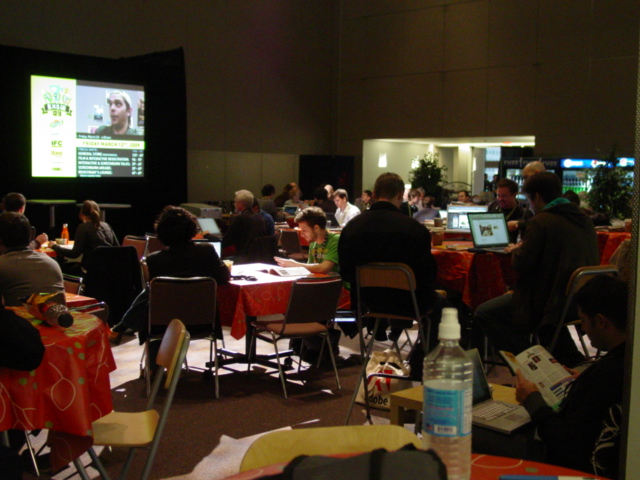
I’m sitting outside the press booth at the famed SXSW waiting for the kick-off panels to begin.  Interestingly enough, I was scheduled to come here in 1989 with my  musician boyfriend.  Something came up at the last minute, and we were derailed.  Even then, SXSW was a mecca.  It was the must-attend event on the planet for the creative, the cool, and the kooky.  Of course in 1989, music dominated SXSW, not the Internet.

I’ve lived in Austin for over a year now, but this is my first SXSW.  The scene here is exponentially more vibrant than its scruffy beginnings, yet its pull on the avante garde is magnetic.  I’m here attending SXSWi (the Interactive conference).  The hundreds of developers, designers, and visionaries who are creating the energy and new application of digital behavior flock here to learn, teach and inspire.  What’s so interesting about SXSWi is that it’s not New York and it’s not Silicon Valley.   Ideas that are generated here in Austin will export around the world.  The emphasis is on sharing and connecting.

I will be on the lookout for enterprise application of some of the concepts and tools I see here.  If you’re here, please DM me; I will be attending sessions all weekend.

Jive Goes Bigger (Than Ever)


Now Business Is Social from Jive Software on Vimeo

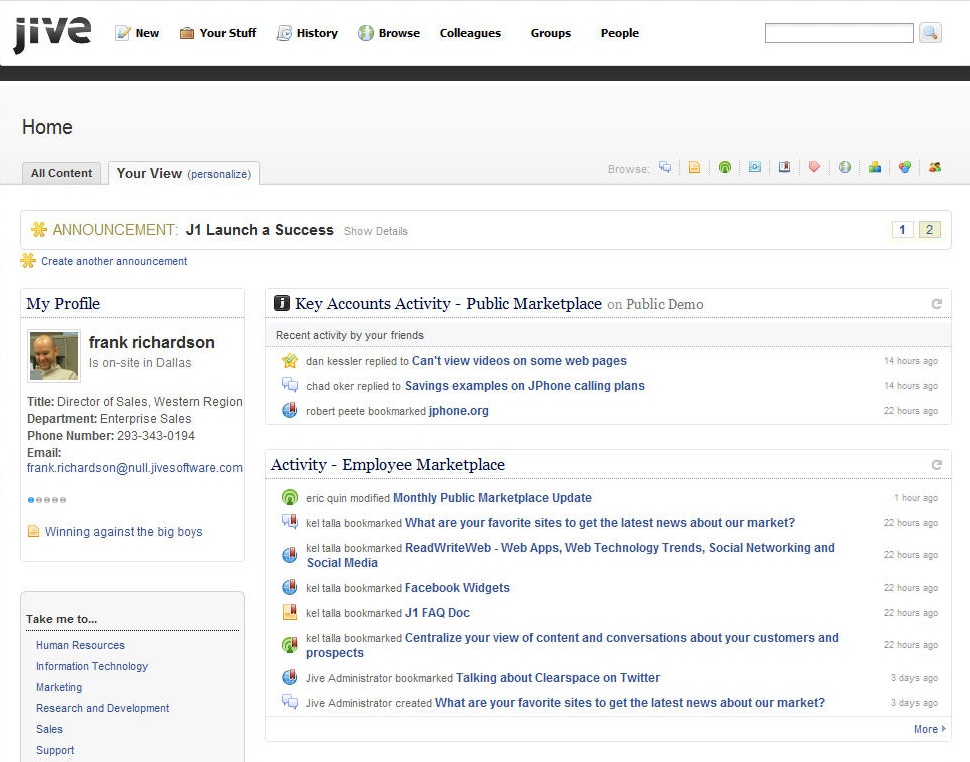
I’m not sure you can announce your leadership in a category, but that’s what Jive has done with the announcement of its Social Business Software application suite — Jive SBS 3.0. The product does bring a deliberate focus to the logical organizational interests of a social enterprise– namely, Employee Engagement, Marketing & Sales, Customer Support, and Innovation. With that segmentation, along with an overhaul of its Jive Clearspace 2.5 released last summer, the software has been reborn– perhaps in the original image of its founders, according to Sam Lawrence, Chief Marketing Officer. With this new release, Jive is stridently targeting IBM and Microsoft customers with what could prove to be a superior solution.

Lawrence is the beloved Enterprise 2.0 author of the “Go Big Always” blog. For years, he has been framing the issues facing the “category” in entertaining and educational ways. For the wholesale formulation of the category (re)definition, Lawrence solicited help from customers, industry analysts, and other influencers. Lawrence sees the market space in terms of a vast social capital marketplace where business intelligence meets interpersonal relationships. It’s powerful stuff and the software now enables levels of insight that were unavailable from one company until now. The emphasis Jive is taking toward effecting business results is also refreshing.

The key new enhancements include:

  • Bridging: The ability to view employee, customer, and partner communities in a centralized, customizable dashboard.
  • Analytics: Indicators that cull from a data warehouse and track activities in the enterprise
  • Insights: Detailed reporting including sentiment and engagement
  • Video: Secure, high quality video for conversation and training
  • Social Bookmarking: Capture and share content from internal and external sources
  • User Experience: A refreshing, simple and elegant look and feel that spurs adoption

Jive says beta versions of its new product suite are in the hands of customers today. We’ll be looking for customer feedback on how the transition is going. In the meantime, Jive has taken a tremendous leap ahead. I would have liked to have seen an enterprise micro-blogging capability, such as Socialtext recently announced with its AIR-based Signals, or more comprehensive wiki capability for deeper collaboration among work teams. With that said, however, I give Jive much credit for taking the lead on forcing a category definition and building its future on the back of that architected vision.

jive_bridging_image

Recession-ready 2.0 Stimulus Packages, the series.

First post in a series of great products that will help jumpstart the economy.

picture-51

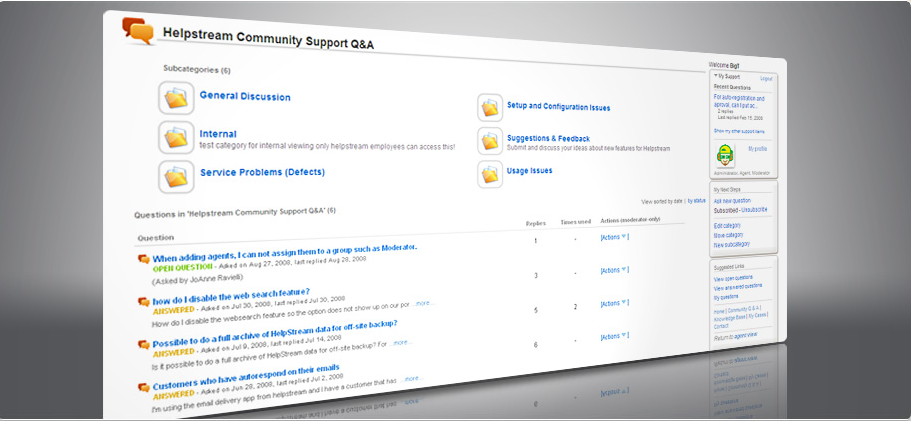
I had a great interview and demo yesterday with someone I admire in the blogosphere, fellow EI Bob Warfield. More than a few times this year, I’ve checked out his stealthy, yet healthy company: HelpStream. What the world needs now is not Love, Sweet, Love or Skittles, it’s products that help create profitable relationships and foster customer loyalty. HelpStream is one of a number of fantastic tools in the market that can help an enterprise improve their customer experience while improving their balance sheet.

With impressive ROI analytics and a gorgeous, easy to use UI, HelpStream goes far to give customers solutions with a minimum of effort and offers companies the means to engage customers on their own terms relying on a searchable knowledge base and self-supporting Web community. Particularly suited for web savvy and web-centric companies, HelpStream brings a social advantage to customer engagement. Further, tight integration to Oracle CRM and Salesforce enables (from the site) “customers and service representatives to search solution articles, post and answer questions, participate in group discussions, engage in idea brainstorming, utilize Interactive Checklists (step-by-step instructions), and instantly transition between unassisted and service rep-assisted processes at any time. In addition, customer service representatives using the pre-integrated solution access all of this information from within the Oracle CRM On Demand or Salesforce system.” What’s most impressive to me is Bob can demonstrate a ROI for HelpStream in months, not years. Ask him to show you the chart.

We got to talking about how there is a lack of awareness outside of the echo chamber regarding the power of communities and socio-collaboration. He said he hears the comment, “I had no idea that was even possible” all the time. There are areas within enterprise that should be moving quickly to embrace social leverage. One of the most obvious to me is customer experience/customer satisfaction. There is simply no better way to treat your customers well and demonstrate the value of democratic leadership and innovation than engaging them in a meaningful, responsive community that is open to ideas and criticism.

UPDATE 3/6:  CRM guru Paul Greenberg validated my opinion on HelpStream.  Excellent analysis of CRM 2.0 on Paul’s blog.

And the Academy Award goes to… Atlassian.

picture-7Atlassian is the Enterprise 2.0 sector’s Slumdog Millionaire. It’s an inspiring rags to riches story of two young college graduates who set out to earn at least a “graduate salary” (approximately $30K/yr USD) by creating a business, rather than taking a corporate job like their university friends did. Now, Mike and Scott were not living in a slum and neither did pure luck have anything to do with their fortune; moreover, their example is establishing a high bar for success for enterprise social software startups.

Last week, I got into a bit of a snit with Atlassian’s marketing folks on Twitter because they approached me about writing a post on Atlassian reaching $100M in all time revenue. Now, I knew the company was a growth engine, but I found it hard to believe they’d become a $100M company since the last time I had spoken to them. It turns out it was all a big misunderstanding. Mike Cannon-Brookes told me today that from the beginning, Atlassian’s backoffice systems have been tracking total cumulative revenue. On February 17th, the company had crossed the $100M threshhold. Mike actually tweeted it and Atlassian’s Laura Kahlil blogged about it on the Atlassian blog the next day. I didn’t understand the significance of the $100M cumulative number and was concerned people would mistake the number for annual sales. Listening to Mike talk about how they noticed the number and got excited about it as a milestone made it obvious to me I was wrong to give them a hard time.

I wrote about Atlassian in October of 2006. They impressed me then, and their continued success is a bright light in otherwise dismal economic news. Atlassian has pumped millions into the Australian economy and has created hundreds of jobs around the world (Atlassian has offices in 5 cities, including San Francisco). Further, their strong organic growth is a testament to the power of listening to your customers and focusing on delivering products customers love.

We can debate product features and what’s fashionable in enterprise social software for days on end. But in today’s economic climate, I celebrate success, job creation, growth, and independence.

Kudos to the Atlassian team.

(For longtime ITSinsider readers… it wasn’t lost on me that Michelle and Barack chose Etta James’ “At Last” for their ballroom dance on the night of the inauguration. )

Update: Just found out Mike was nominated by the World Economic Forum as a Young Global Leader for 2009. Smile.

Enterprise Social Networks are hot for ’09. But, are you ready?

Thanks to the AWESOME new e20global Twitter ID list, I found @sameerpatel‘s tweet on Deloitte’s new report on Social Networks for the Enterprise. Deloitte is predicting nearly half a billion dollars will be spent in 2009 on internal and external social networking solutions. Similarly, Pew Internet released a report this month that demonstrates casual use of social networks is growing in leaps and bounds for adults in the U.S. which means the concept of a “Facebook for the Enterprise” will be more familiar and possibly welcome.

So, social networking for the enterprise is coming, but will you be ready?

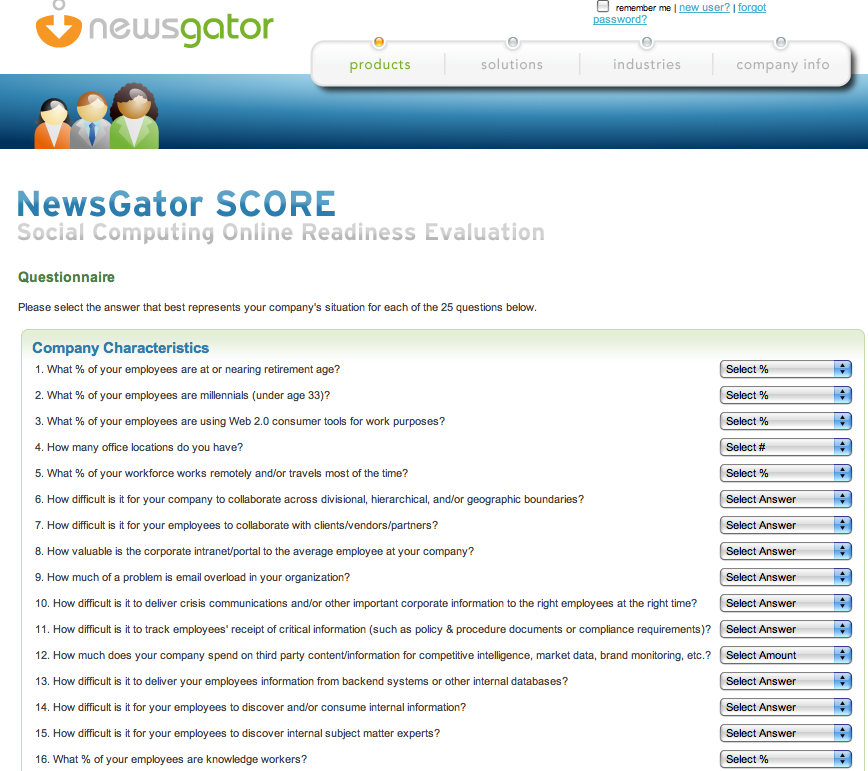
To find out, you might want to try NewsGator’s new nifty assessment tool. It’s really easy to use and it’s free. Regardless of how your organization does on the assessment, it’s a great conversation starter to begin the discussion surrounding the goals for collaboration and social networking at your company or organization.

picture-2

The SCORE tool takes you through a series of simple questions, and then makes recommendations on vendor-neutral tools and benefits you can expect from your social networking and collaboration efforts. And I’ve said this before, if you’re considering SharePoint, you simply must talk to NewsGator. Its Social Sites offering is a social goodness booster to MOSS. Check it out, srsly.